


A trial order looks small on the invoice and does a large amount of work. For the price of a few finished pieces, you learn how a factory communicates, whether its stones arrive at the sizes you ordered, how it packs, and how it behaves when something goes wrong. That is what the first order is for. The margin question comes later, once you know whether reordering is a pleasure or a gamble.
Most sourcing advice tells you to compare quotes. Quotes are the easy part; any list can look competitive on a spreadsheet. The hard part is judging a supplier on the things that only show up inside an order. Here is what a small first order should test, the questions worth asking before you pay, and how to read the answers.
What a Trial Order Should Actually Test
Think of the first order as an audition with five checks. Each one maps to a failure mode that shows up later at scale, when it costs far more to discover.
1. Reply speed and reply quality. Note how long the first answer takes, and read it carefully. A useful reply names sizes, materials, and timelines in concrete terms. A reply that says only “yes, we can do, send inquiry” tells you the next six months will be spent extracting information one sentence at a time.
2. Stone calibration. Order a few loose stones alongside finished pieces and check them against the spec you sent — actual millimeter diameter, not carat weight rounded to a label. Calibration is the habit that separates a factory from an assembler. If a 6.5mm stone arrives at 6.2mm and the reply shrugs, your settings will not seat, and every reorder inherits the problem.
3. Pair matching, especially on earrings. Earrings get judged as a pair, on the same ear, at the same time. Two stones a half-grade apart in face-up color, or two settings with the stone seated at different heights, read as defective even when each piece alone is fine. A supplier who measures pairs against each other before packing is a supplier you can scale with. Our earrings page describes the three pair-matching checks we run; ask any candidate supplier what theirs are.
4. Finishing on the metal. Look at prong tips under magnification, the inside of the band or gallery, and the polish on surfaces that do not show in photos. The areas a factory finishes when nobody is watching are the areas your customers will eventually see.
5. How the problem is handled. Something in the order will be imperfect, because that is true of every factory on earth. What matters is the reply: does the supplier name the defect first, or wait for you to find it? The second-order decision — whether to scale up — is really a decision about which kind of reply you got.

Questions Worth Asking Before You Pay
The questions below are the ones buyers actually send us, many of them phrased the way a search box gets used. A serious supplier answers each one specifically; a weak one answers generically. Compare the answers across two or three candidates and the gap between factories becomes obvious.
- Which standard stone sizes do you hold in stock, and which do you cut to order? Stock behavior and cut-to-order behavior have different timelines, and a supplier who cannot split the list has not looked.
- Do you cut stones to the millimeter spec I send, and what happens if a finished stone lands outside it? The honest answer involves a replacement policy, not a shrug.
- Can you match a pair of stones for earrings, and what exactly do you check? Diameter, face-up color, and seat height are the three answers to listen for.
- How fast is CAD for a custom design, and how long from approved drawing to physical sample? Concrete numbers are a good sign; “it depends” without a range is not.
- Do finished pieces ship with certificates? This one deserves its own section, below.
- What did you change in your process after your last quality complaint? Factories that inspect honestly can answer this. Ones that only inspect for the photo cannot.
Certificates and Grading Consistency: What Paperwork Can and Cannot Do
Buyers ask whether bulk orders come with certificates, and the honest industry answer is more specific than most listing pages make it sound. A GRA certificate card, the document that ships with most moissanite, records the specifications a stone was sold under: shape, size, color notation. It is not a laboratory grading report produced by independent inspection, and treating it as one sets up expectations that the stone was never promised to meet.
Our policy states this plainly. A GRA card does not ship by default; when you want one, it is added at a fixed fee that appears as its own line on the quote, so you can decide per order whether the paperwork earns its cost. IGI reports, which involve sending stones to a laboratory, are a different arrangement with a fee that runs several times the cost of the stone or the setting, borne by the buyer; we handle them when a client genuinely needs one and say so when they do not.
The consistency that matters in bulk orders, meanwhile, is not produced by paper. It comes from cutting stones to the same spec across a parcel and checking pairs and batches against each other before packing. Ask a supplier how they keep parcel ten identical to parcel one; the quality of that answer tells you more than any certificate in the box. The full policy is on our certification page.
Custom Designs Versus Catalog Designs
“Which factory can make custom moissanite earrings?” is one of the most common questions buyers send, and the answer is usually yes from everyone; the differences hide in the process. A workable custom program has three visible parts: a drawing turnaround measured in days (ours runs 72 hours from brief), a physical sample stage before production (about 7 days after you approve the CAD), and a willingness to produce the sample in the metal you actually intend to sell. A supplier who wants to skip the sample stage is asking you to debug the design in production quantities.
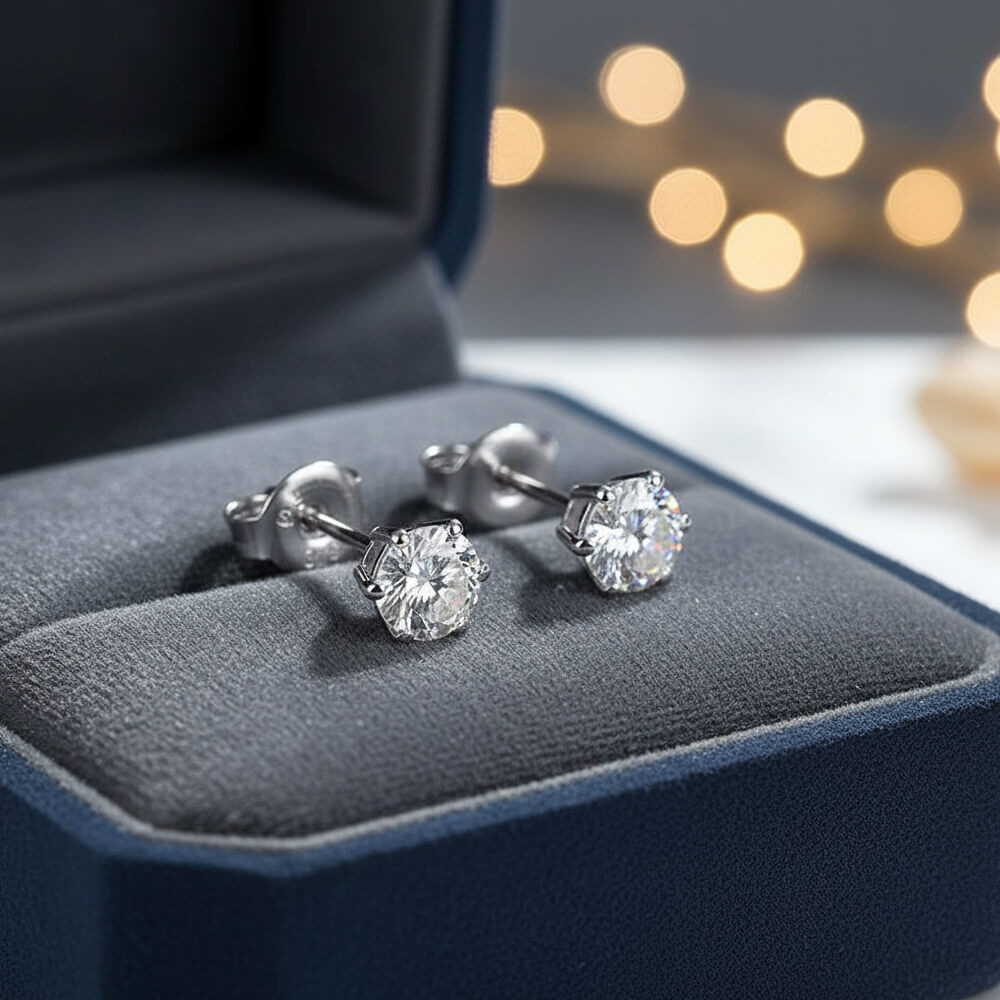
Catalog designs are the complement, not the competitor. Existing settings ordered as-is with your branding move faster and carry no design risk, and they are the right base for a first collection while the custom pieces develop. A factory that steers you entirely toward catalog has a bench problem; one that steers you entirely toward custom has a margin problem. Rings and earrings both work well as starting categories, since a first line can mix catalog bodies with your own stone choices.
Red Flags in a Supplier’s Reply
Some replies look helpful and are not. Watch for these patterns:
- Every answer is yes. Real factories have limits — stones they will not cut, timelines they will not promise, designs they will decline. A supplier with no limits has not read your spec.
- Timelines never include a range. “Fast” is not a schedule. A factory that knows its bench gives you days, not adjectives.
- Photos that cannot be produced on request. Stock photos answer nothing about the stones you will receive. A current photo of the actual parcel, taken that week, is a reasonable ask and a revealing refusal.
- Certificate talk that avoids the word “fee”. If paperwork appears free and unconditional in the reply, expect either a surprise on the invoice or paperwork that means less than it sounds.
How Trial Orders Run Here
We keep the first order small by design: no minimum order quantity, and the common standard sizes held in stock so the trial tests our production rather than our lead times. A trial typically combines loose stones with one or two finished pieces, so calibration and finishing are both checked in a single shipment. Custom work enters the same way: CAD within 72 hours, a physical sample about 7 days after approval, and a clear answer at the quote stage about which parts of your spec draw from stock and which are cut to order.
We also answer the awkward questions directly. Silver weight, stone size, and design drive the quote; the GRA card is a fixed add-on line you opt into; IGI is rare, expensive, and your call. A first order is where a supplier gets to prove that honesty is the operating system rather than the sales pitch. If you want to run that test, send us the spec.
Frequently Asked Questions
How small can a trial order be?
As small as the information you need it to be. A few loose stones and a single finished piece already test calibration, pair matching, finishing, and packing. We carry no minimum order requirement, so the size is your call, not ours.
Should the trial order include loose stones or only finished jewelry?
Include loose stones if you can. Finished pieces alone test the setting bench; stones alone test the cutting bench. The combination in one shipment shows you whether the two halves of the operation agree on the same spec, which is the question your reorders will keep asking.
Can I start with my own earring design instead of your catalog?
Yes. Send a sketch or a reference piece with the spec: stone shape, sizes, metal. CAD comes back within 72 hours, and a physical sample about 7 days after you approve the drawing. Custom and catalog designs can travel in the same trial shipment, which is the most efficient way to compare them.
Do trial orders come with certificates?
Not by default. A GRA certificate card can be added at a fixed fee that appears as its own line on the quote, and it records the stone’s specifications rather than acting as a laboratory grading report. The full policy, including when an IGI report makes sense, is on the certification page.
Request a Trial Order Quote → · See the Full Wholesale Program → · Read the Certification Policy →
Sourcing across categories? See moissanite jewelry supplier China, for loose stones, stock sizes and custom production under one roof.