


A pendant order is two products pretending to be one. There is the piece people look at, and there is the chain that decides how it wears, how it falls, and how long it survives daily use. Buyers who spec only the pendant and let the chain be “standard” are the ones who discover the mismatch after the photoshoot.
This guide covers the five decisions that make a pendant line repeatable: setting style, chain length, link weight, clasp, and the bail that connects the two. Each one is inexpensive to specify at the quote stage and expensive to fix after production.
The Five Specs That Define a Pendant Order
Before a CAD is drawn, these five fields should be settled in writing. They also happen to be the fields most often left as “you decide,” which is how a factory’s default becomes your product.
- Setting style: how the stones are held on the pendant face.
- Chain length: stated in inches and centimeters, per style, not one length for the whole line.
- Link style and weight: the chain’s construction and grams per length, which together control how the piece drapes and how long the plating lasts.
- Clasp: type and finish, because the clasp is where plating dies first.
- Bail: the loop the chain passes through, sized to the chain rather than to the pendant.
Setting Styles on the Pendant Face
Four constructions cover most commercial pendant lines, and the choice changes both the look and the QC checklist.
| Setting | How it reads | Where it fails |
|---|---|---|
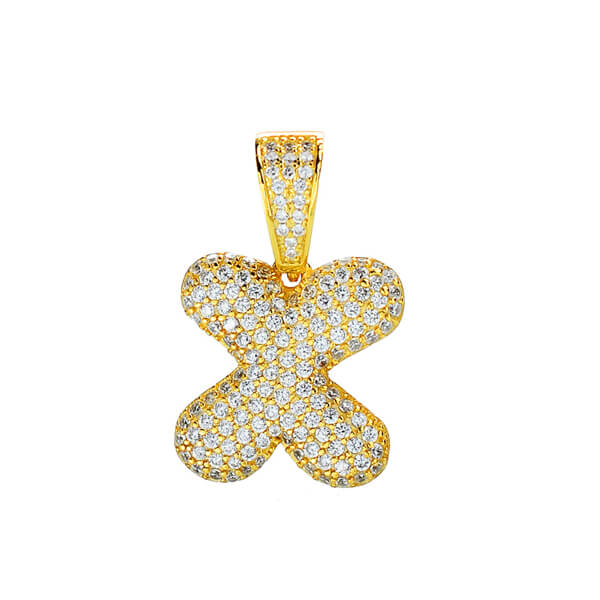
| Full-set / pavé face | Stones across the whole face, no visible metal field | Accent calibration; one undersized stone shows as a gap in the pattern |
| Halo around a center | A rim of accents framing one larger stone | Halo stones must be cut to the rim’s seat, and the center must sit level |
| Prong-set center | One stone held by four or six prongs, metal visible around it | Prong tips that are shaped unevenly or left rough |
| Bezel | A metal rim enclosing the stone’s edge | Rim thickness and closure; an uneven bezel reads as a defect at arm’s length |
Letter and motif pendants, from A to Z initial pieces to shaped designs, usually combine a full-set face with a prong or bezel center. Our custom pendant line is built this way, and it is the format most brands start with because one mold serves a whole alphabet.
Chain Length Is a Product Decision
Length is not a size attribute, it is a design decision. The same pendant at 18 inches and at 24 inches is two different products for two different customers. State the length per style at the quote stage.
| Length | Where it sits | Common use |
|---|---|---|
| 16 in / 40 cm | Base of the neck | Close-fitting pendant lines |
| 18 in / 45 cm | Collarbone | The default for most pendant programs |
| 20 in / 51 cm | Just below the collarbone | Layering and unisex lines |
| 22 in / 56 cm | Mid chest | Larger pendants that need room |
| 24 in / 60 cm | On top of clothing | Statement pieces and men’s lines |
| 30 in / 76 cm | Long layer | Layering with shorter chains |
We hold 18, 20, and 24 inch lengths as standard, in 45, 51, and 60 cm, and cut custom lengths when a design needs one. Two things to write into the spec: the length with its tolerance, since a chain that arrives an inch short changes where the pendant sits, and the extension detail if the design has one.
Link Style and Weight
Chain construction decides how a pendant hangs. A round cuban link chain, the format we produce for pendants and necklaces, presents a smooth edge and a consistent face, which keeps the pendant sitting flat instead of twisting. Finer link styles read lighter and suit small pendants; heavier links hold larger pieces steady and are what most men’s lines specify.
Weight deserves its own line in the spec sheet, in grams per length. It is the field that makes a reorder match the first batch, and it is also the honest way to compare two quotes for what looks like the same chain. Two chains can share a link style and a length and still differ by a third in weight.
All of it is built in 925 sterling silver with a gold plating finish, lead and nickel free on the pieces where that is specified. Plating thickness matters most on the links’ outer edges, which is where wear begins, and it is worth asking explicitly rather than assuming “gold plated” means the same thing at every factory.
The Clasp and the Bail
These two small parts decide whether a pendant feels finished or fiddly.
The clasp gets operated twice a day, so its ergonomics matter as much as its strength. A box clasp that needs two hands and a fingernail is a return reason on its own; the updated clasp design we use on pendant chains opens and closes with one hand and keeps the profile low. Ask what plating coverage the clasp gets, because it is the highest-wear component on the piece.
The bail should be sized to the chain, not to the pendant. A bail opening that is too tight will not slide; one that is too loose lets the pendant hang off-axis and photograph crooked. The bail’s solder joint is also a classic failure point, which is why it belongs on the sample checklist rather than in the catalog copy.

What to Check on a Pendant Sample
- Stone tightness across the face. Run a fingernail across the settings; a stone that moves is a stone that will fall out.
- Bail orientation. Hang the pendant from a chain and look at it straight on. It should face forward without help.
- Clasp operation. Open and close it ten times. If it is already awkward, daily use will not improve it.
- Plating at wear points. Look at the clasp, the bail, and the chain’s outer link edges under light. These show thin plating first.
- Length and weight against the spec. Measure the chain flat, then weigh it. Both numbers should match what the quote stated.
- Consistency across multiples. If you ordered several, compare them to each other, not just to the drawing.
Frequently Asked Questions
-
Can I order pendants and chains separately?
Yes. Mixed orders are accepted, so a line can combine pendant bodies with several chain lengths and weights in one shipment rather than several.
-
What chain length should a first pendant line use?
18 inch is the safest default because it suits the widest range of customers. Add 20 and 24 inch as variants rather than guessing which one your audience prefers.
-
Can I supply my own letter or motif design?
Yes. Custom designs come back as CAD within 72 hours and as a physical sample about 7 days after drawing approval, and a single design can be sampled before committing to a line.
-
Which stones go into a pendant?
Calibrated moissanite cut to the seat dimensions in the CAD, with accent stones cut to their own seats. The loose stone guide covers how those specs are written and checked.
-
Do pendant chains ship with certificates?
Not by default. A GRA certificate card can be added at a fixed fee as its own line on the quote and records specifications rather than acting as a grading report. The full policy is on the certification page.
Send a Pendant Spec → · Browse Silver Jewelry → · Read the Wholesale Overview →