


Finished jewelry flatters a stone. Prongs, polish, and store lighting do half the work before the customer forms an opinion. Loose stones flatter nothing: a parcel either matches the specification you sent or it does not, and the difference is visible on white paper in daylight. That is why experienced brands test a factory on loose stones before trusting it with finished pieces, and why the parcel you order first will tell you more about a supplier than any product page.
This guide covers the decisions that go into ordering loose moissanite: which shape fits which kind of line, why millimeters matter more than carat labels, what stock availability means for your lead times, and the spec fields that make reorders repeatable.
The Twelve Standard Shapes
Twelve shapes are standard at our cutting line, with specialty cuts made to drawing when a design needs one. The table below maps each shape to where it typically earns its place in a commercial line. Treat it as guidance rather than law: shape follows the setting, and the right answer is always the one your mounting requires.
| Shape | Where it works hardest |
|---|---|
| Round brilliant | Solitaires and studs; the most light return per millimeter, and the easiest shape to pair-match |
| Oval | Bridal lines that want an elongated look on the finger without the premium of a larger round |
| Emerald | Step-cut designs with a hall-of-mirrors depth; unforgiving of body tint, honest of cut quality |
| Pear | Teardrop pendants and east-west ring settings |
| Marquise | Maximum visible spread for the size; vintage-leaning lines |
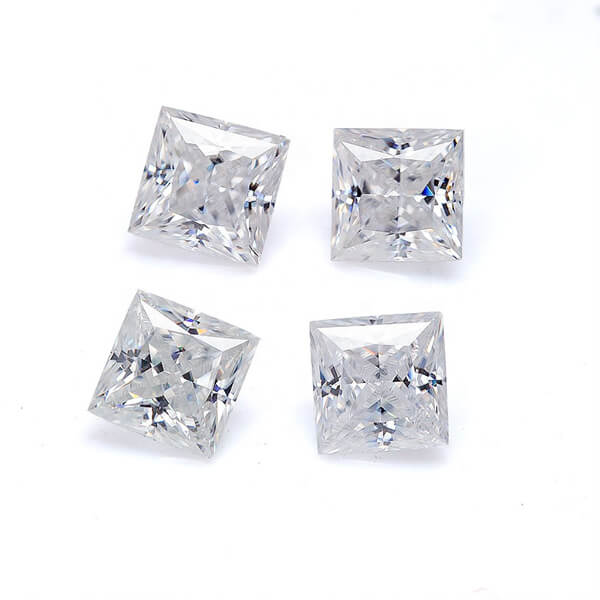
| Princess | Sharp-cornered modern settings; a common centerpiece for fashion collections |
| Radiant | Brilliant faceting in a rectangular outline; a frequent choice for halo builds |
| Cushion | Soft-cornered vintage and pavé work |
| Asscher | Square step cuts in art-deco style lines |
| Heart | Gift and sentiment collections |
| Baguette | Channel settings and linear accents |
| Trilliant | Side stones and triangular accents flanking a center stone |
If you are building a line rather than buying for an existing one, start from the mounting you plan to repeat and work back to the stone that fits it. Shape choice made this way rarely gets revised; shape chosen first usually does. Our silver ring catalog is a good reference for the seat sizes the current settings use.
Millimeters Before Carats
Carat weight tells a setter nothing. Two stones of the same carat weight can differ in spread, depth, and the diameter that actually lands in the seat. Calibration is the specification that matters: the millimeter diameter the setting was drawn around.
Every stone here is cut to a millimeter diameter you can set against. If your CAD seat is drawn at 6.5mm, the stones that arrive measure 6.5mm, not a parcel that averages 6.5mm while ranging from 6.1 to 6.9. Those are two different products, and only one of them will set without rework. When you compare suppliers, ask what their tolerance around a stated size is, and whether it applies to every stone in the parcel or to the average.
Stock Sizes Versus Cut to Order
Common standard sizes are held in stock and ship without a cutting cycle. Anything outside the standard range is cut to order against your spec. The quote stage tells you which side of that line your stone falls on, which is the difference between planning a launch from a date and planning it from an estimate.
Ask every candidate supplier the same two questions: which sizes are actually on the shelf, and what the cutting time is for a size that is not. A factory that cannot answer either is a factory that discovers its own lead time when your customer is already waiting. Our loose stone category lists what is currently in range, and quotes name the stock position for anything outside it.
Parcel Consistency: The Reorder Test
Buying loose stones in volume is a repeatability problem. Parcel ten has to look like parcel one six months later, or your reorders turn into redesigns and your product photos start disagreeing with your inventory.
The way this is solved is boring and essential: cut against the same written spec across the whole parcel, and check stones against each other before packing rather than relying on the cutting machine alone. When you evaluate a supplier, ask how they verify consistency within a parcel. The answer you want involves a bench, a tray, and human eyes; the answer to be wary of involves only equipment names.
Pair Matching for Earrings and Three-Stone Settings
Some products judge stones as a group. Earrings get read as a pair, on the same ear, at the same time, and a mismatch reads as a defect even when each stone alone is acceptable. Three-stone ring settings do the same to a center stone and its accents.
Pairs are matched on three checks: diameter, face-up appearance, and the seat height the setter will work with. Those three together decide whether the pair reads as a pair on the ear. If earrings are on your line, the earrings page shows how the same checks carry into finished pieces.

How to Send a Stone Spec
A workable spec is four fields long:
- Shape. One of the twelve standard cuts, or a drawing for a specialty cut.
- Millimeter size. The diameter the setting requires, not a carat weight you converted from another supplier’s label.
- Quantity. Singles, matched pairs, or parcel quantities; the process is the same at any size.
- The setting. What the stones are going into, since seat geometry and accent work change what “correct” means.
Add one line if you want paperwork: a GRA certificate card can be included at a fixed fee shown as its own line on the quote. The reply comes back with stock position, cutting time if the size is non-standard, and the certificate line item if you asked for one.
A first parcel is best kept small and mixed: a few calibrated sizes to test, one or two larger stones for a centerpiece. That is enough to check calibration against a gauge, consistency across the parcel, and how the stones are packed, before you commit a full production run to one supplier. The trial order guide covers how to combine loose stones with finished pieces in a single first shipment.
Frequently Asked Questions
-
Can I order a single loose stone?
Yes. There is no minimum order quantity, so one stone and a hundred-stone parcel travel through the same process and the same checks.
-
Should I order by carat weight or by millimeter?
By millimeter. The setting is drawn in millimeters, calibration is checked in millimeters, and carat labels vary with depth and spread. Send the seat dimension and the parcel is cut to it.
-
Can I mix shapes and sizes in one parcel?
Yes. Mixed parcels are the normal shape of a first order, and they are also a better test: you see how the factory handles several specs in one shipment rather than one.
-
How do I know if a size is in stock?
The quote names it. Standard sizes ship without a cutting cycle; anything outside the standard range is cut to order with the cutting time stated on the quote, not guessed afterward.
-
Do loose stone parcels come with certificates?
Not by default. A GRA certificate card is available at a fixed fee as its own line on the quote, and it records the specifications a stone was sold under rather than acting as a laboratory grading report. IGI reports are a separate arrangement and rarely worth their cost for moissanite; the certification page explains both.
Send a Stone Spec → · Browse Loose Stones → · Read the Wholesale Overview →