


Pick a stone line and you have made four decisions at once: your unit economics, what documentation you have to carry, how returns will be handled, and what your sales team has to learn to say. This guide is written for the person sourcing stones rather than the person buying one ring, because the questions are not the same. A consumer asks which stone looks best. A brand asks which supply line can carry a collection.
Three materials, three definitions
Natural diamond is crystallized carbon, formed underground over a very long time.
Lab-grown diamond is also crystallized carbon, grown in a laboratory by CVD or HPHT. It is diamond: same chemistry, same crystal structure, same optical behavior. Grading labs report it as diamond because that is what it is.
Moissanite is silicon carbide. Natural moissanite exists only in microscopic grains, so everything sold as moissanite is lab-created. It shares nothing with diamond except that it is hard, transparent, and cut by the same benches.

This matters in a practical way: the material decides which documents a stone can carry, and what your customer is allowed to be told.
Hardness, and what actually breaks
Diamond sits at 10 on the Mohs scale. Moissanite sits at 9.25, above every other common jewelry stone.
Both survive decades of daily wear. The difference surfaces at facet junctions under a hard knock, and in stones set with thin prongs where any chipping shows. Bridal and everyday lines are safe in either material. Men’s heavy bands and tennis bracelets that get worn without being taken off are where diamond’s extra toughness earns its price.
Fire, brilliance, and the photograph problem
Diamond: refractive index 2.42, dispersion 0.044. Moissanite: refractive index roughly 2.65 to 2.69, dispersion around 0.104. In plain terms, moissanite returns more colored light, and it does it more visibly as the stone gets larger.
Two commercial consequences follow. A customer anchored to “what a diamond looks like” may read moissanite’s rainbow flashes as too much. And under studio lighting for a product page, moissanite photographs louder than it wears. Shoot both stones with the same setup and the comparison will work either for you or against you, depending on which line sits where on the page.
One thing worth knowing before you commit to a line: thermal diamond testers can read moissanite as diamond, because silicon carbide moves heat the way the tester expects. A single heat pen is not identification. If your QC relies on one, add a refractometer reading or a second test before anyone makes a claim to a customer.
Price: the order never changes
Natural diamonds cost the most, by a wide margin. Lab-grown diamonds price well below natural, and the gap has widened as production capacity has grown. Moissanite prices at a fraction of either, low enough that on a finished ring the metal and the labor drive your bill of materials more than the stone does.

What that buys you:
- On moissanite, a large-looking center stone inside a price point diamond cannot reach.
- On lab-grown, diamond authenticity for customers who care that it is a real diamond but not where it came from.
- On natural, the things only natural carries: origin, rarity, formation time.
Every quote is its own arithmetic. Ask per design rather than assuming a ratio holds.
Certification, which is where disputes start
The full policy — what ships by default, what the GRA card costs, and when an IGI report makes sense — is on our certification page.
Natural and lab-grown diamonds can carry reports from independent laboratories. IGI grades the full 4Cs and gives you a report number you can look up. GIA grades diamonds too, with one change to know about: since 1 October 2025, GIA’s lab-grown reports use “premium” and “standard” categories instead of the D–Z color scale and FL–I3 clarity scale. If a customer puts an older GIA report next to a newer one and the fields do not match, that is why. IGI reports still carry the full 4Cs, which is part of why IGI remains the common document in the lab-grown trade.
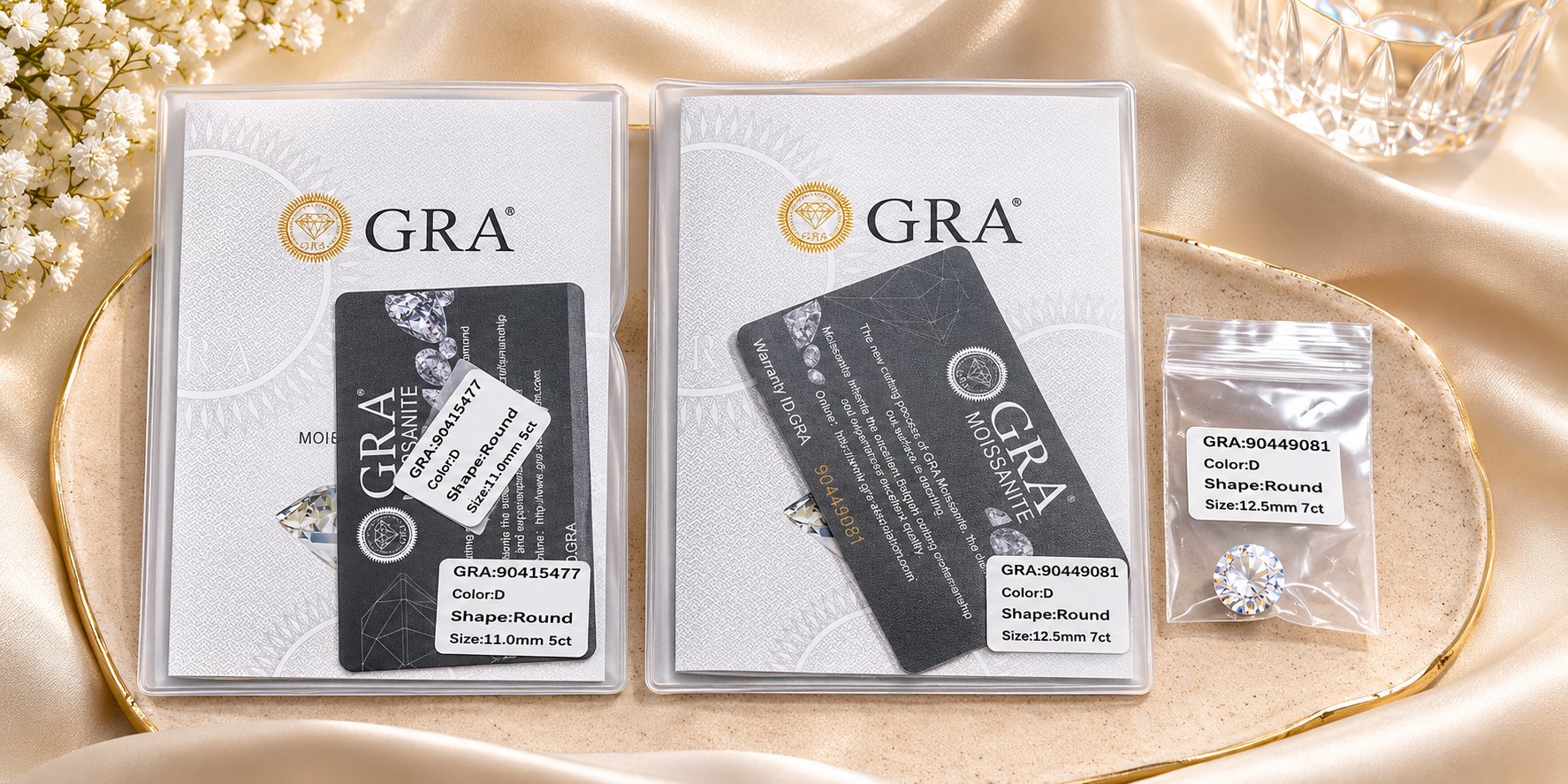
Moissanite carries a GRA card: a specification record from a trade body serving the moissanite industry, listing shape, measurements, carat weight, color grade, and clarity grade. Those figures repeat the description the parcel was sold under. They are not the output of independent laboratory analysis, and no laboratory grades silicon carbide on the diamond scale. GIA does not grade it at all. Routine IGI grading of moissanite is possible but we do not recommend it: the stones travel to a laboratory, the fee runs to several times the cost of the stone or the setting, and the buyer pays it. The document rarely changes a buying decision on a stone at this price. A supplier advertising “GIA certified moissanite” is using a name that does not apply here, and it is better to notice that before you repeat it in your own product copy.
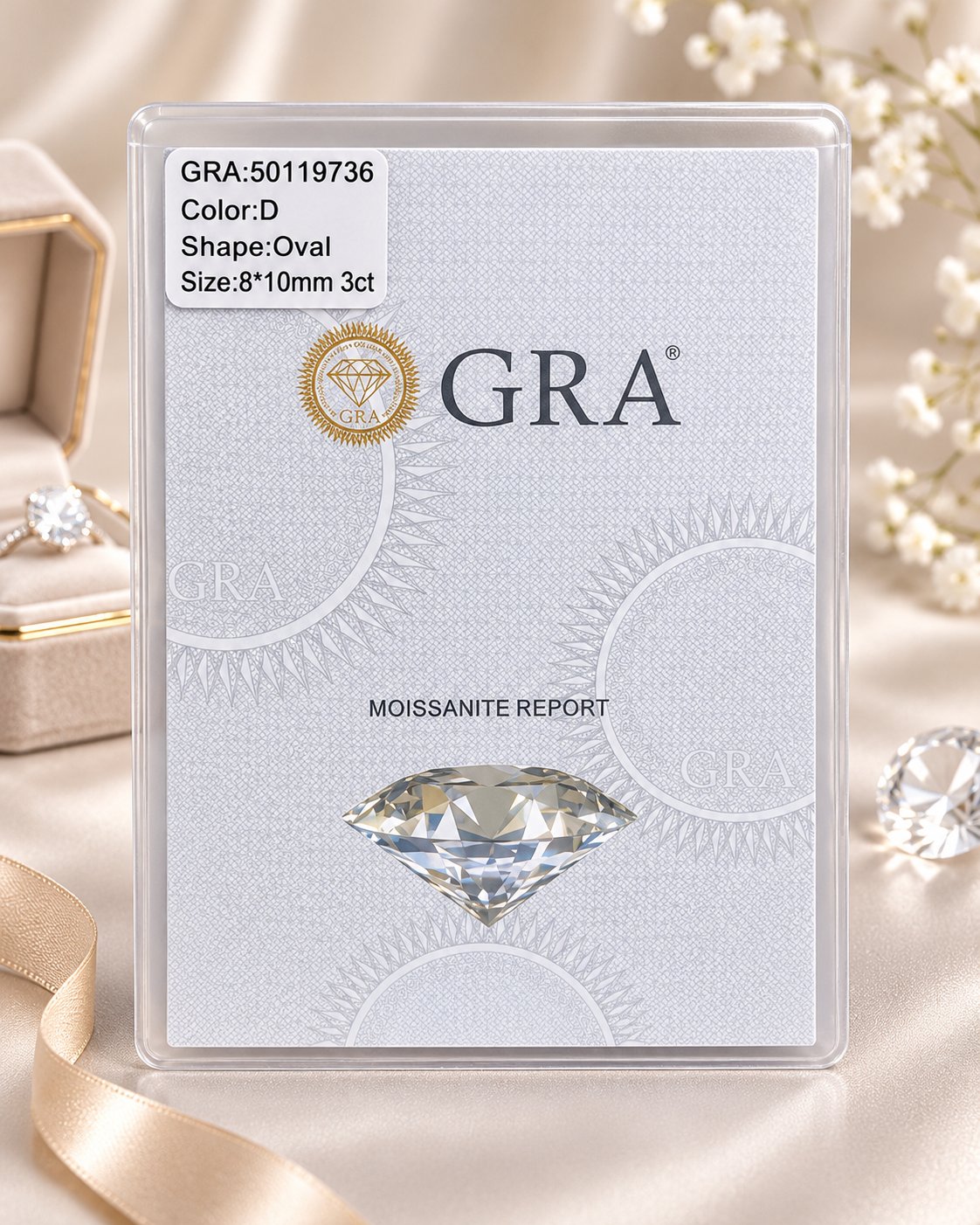
One more point, because it decides how you quote: documentation is a cost, and it should be visible as one. Where a supplier puts a card in every box, the cost of that card sits inside a unit price you cannot take apart. Quoting documentation as a separate line item is the cleaner arrangement. You see the number, you decide whether your market needs it, and a stone shipped without a card is the same stone off the same cutting line — the paperwork is simply absent, and the card fee is simply not on the invoice.
Which line for which business
Bridal at accessible price points: moissanite that reads colorless face-up and eye-clean in the hand, or lab-grown where the audience insists on diamond. Moissanite bridal is a mature category now, not a compromise.
Fashion and demi-fine: moissanite. The stone outperforms the price point the line is aiming at, and it takes daily wear.
Fine jewelry selling diamond credibility: lab-grown with IGI reports quoted as a line item. This is the buyer who will ask, and the report is the answer.
Heritage and investment positioning: natural, where the formation story is the product.
Plenty of brands run two of these at once, moissanite at volume and lab-grown at margin. From our side of the bench, the settings, the factory and the QC are shared. Only the stone order changes.
Four questions that decide more than the stone
Calibration. Ask how consistency holds across orders, not within one parcel. A reorder half a millimeter off will not seat in a setting you have already tooled, and by then the stone is no longer the problem you are solving.
Stock. Standard sizes cut to order and standard sizes held in stock behave like two different suppliers. One adds weeks to a restock — our wholesale moissanite page explains which sizes we hold.
Minimum order. If the MOQ forces inventory before you have proof of demand, the stone choice is not the decision that matters most.
Documentation cost. Get the with-and-without numbers on the same order. It takes one email and removes the guesswork.
What we would tell a client
Natural, lab-grown and moissanite answer three different customer questions: origin and rarity, diamond authenticity at reach, or the most stone for the money. Brands that match the stone to the question their customer is already asking get cleaner positioning and fewer returns. Brands that pick a stone because a competitor did tend to inherit a conversation they cannot win.
If you are building a moissanite or lab-grown line and want a manufacturer’s read on specification, calibration or documentation for a specific design, send it over. We cut and set all three, and we will tell you which one we would not use for your case.
Sourcing across categories? See wholesale moissanite jewelry — loose stones, calibrated melee and finished pieces from one factory, no minimum order.